
Copper prices have extended sharply higher into early 2026, driven primarily by macro rotation and systematic flows rather than near-term physical tightness. While the long-term structural bull case for copper remains intact, near-term market mechanics are increasingly misaligned. Physical consumers are pushing back, inventories are building in China, and marginal flow support from the U.S. import arbitrage is fading. Policy optionality around tariffs, combined with the financialisation of inventory, is inhibiting normal adjustment by reducing inventory mobility and blunting the signalling role of spreads.
Price action and macro drivers
The recent rally has shown strong correlation with CNH appreciation and EM Asia equities, suggesting macro-driven allocation into China-exposed cyclicals rather than validation from near-term physical copper demand. CNH strength in this episode should not be interpreted as evidence of broad-based credit expansion, infrastructure acceleration, or industrial reflation in China. Instead, it reflects improved confidence in stability, with downside risks perceived as more predictable and the probability of disorderly depreciation reduced. In a global context marked by U.S. dollar debasement concerns and relative macro fragility elsewhere, this stabilisation has been sufficient to attract capital into China-linked risk assets despite weak underlying physical indicators.
This distinction matters. Macro capital has treated CNH strength as permission to add cyclical exposure, allowing copper prices to overshoot underlying physical signals. As a result, price discovery has been led by financial flows rather than consumption. Technically, copper appears extended, with momentum indicators rolling over and volatility rising. This points to overextension rather than a structural top. A material move lower would likely require a broader macro wobble rather than copper-specific deterioration alone.
Physical market signals, China as the pressure valve
Chinese physical indicators continue to weaken at the margin. Social inventories have risen steadily since early December, copper rod operating rates have fallen sharply, and spot premiums have eroded despite higher futures prices. This combination indicates that downstream demand is not clearing metal at current price levels. China is acting as the system’s pressure valve, absorbing surplus through inventory.
This pushback is not new, but the incremental change is that it now coincides with fading U.S. flow incentives and increasingly crowded speculative positioning. Physical resistance is becoming more consequential as other sources of support lose momentum.
CME–LME arbitrage and U.S. flows
The CME–LME arbitrage, particularly at the front of the curve, has compressed materially in recent sessions. While still marginally positive, the incentive to continue drawing refined copper into the U.S. is clearly fading. This does not imply an immediate reversal of flows, but it removes an important source of marginal demand that helped sustain the rally.
Crucially, even if the arbitrage were to turn negative, it would not necessarily trigger immediate metal release. A significant portion of U.S.-held copper is being used as collateral and carries embedded tariff optionality. In this regime, copper behaves less like mobile inventory and more like a balance-sheet asset.
Spreads, backwardation, and why the curve is not clearing the market
The LME forward curve is backwardated, reflecting uncertainty rather than urgent physical demand. However, the marginal tonne that would normally respond to backwardation is effectively policy-locked in the U.S. and financially repurposed, limiting the curve’s ability to mobilise inventory. As long as tariff uncertainty persists and funding conditions remain benign, backwardation is unlikely to deepen sufficiently to force physical rebalancing through stock movements.
Positioning and who is carrying the risk
CTA exposure is significant across both CME and LME, reflecting momentum- and macro-driven positioning rather than venue-specific considerations. In parallel, a cohort of financial longs on the LME benefits from positive roll yield, while CME warrant holdings largely reflect inventory moved in response to tariff risk and subsequently collateralised by physical or financing-oriented participants. These positions are strategic rather than directional and largely insensitive to short-term price or arbitrage fluctuations. As a result, most long constituencies are economically comfortable, despite growing resistance from physical consumers.
In contrast, producers remain materially net short and have increased forward hedging, consistent with commercial risk management and margin protection rather than allowing price participation at current levels. Swap dealers appear to be trimming directional exposure at the margin, with declining gross long positions and rising gross shorts in recent COT data suggesting reduced intermediation of client short hedges and a lower willingness to warehouse price risk. Physically informed discretionary accounts appear defensive at the margin, with COT data showing net short positioning among reportable merchant and trade-linked participants rather than broad participation in the rally. The physical consumer remains the clearest source of opposition to current price levels, but their influence is muted while the market’s clearing mechanisms remain impaired.
Technical structure and near-term levels
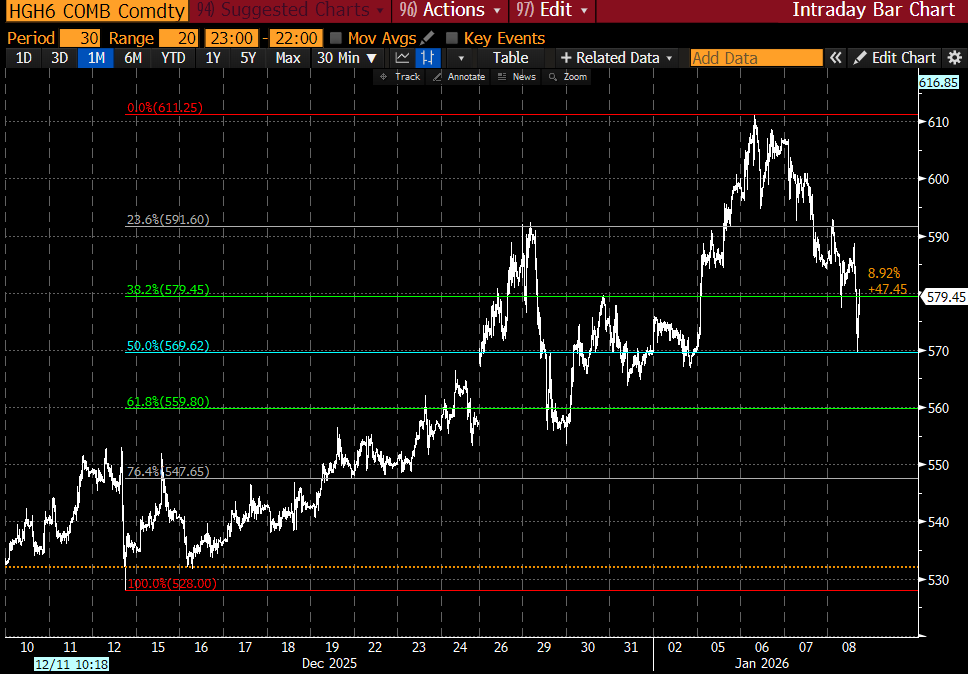
Both LME and COMEX structures point to a corrective phase rather than a trend break. On COMEX, the 20-day moving average around 560 c/lb aligns closely with the 50% retracement of the past month’s rally, from roughly 528 c/lb to 611 c/lb, suggesting scope for a sharp but contained flush that resets positioning without undermining the broader uptrend. The corresponding LME retracement zone around $12,400/mt conveys the same message.
Such a move would be consistent with CTA de-risking, arb compression, and continued physical pushback, without requiring a change in the longer-term supply-demand narrative.
Source: Bloomberg
Implications and near-term outlook
The copper market is currently defined by a misalignment of incentives. Inventory holders are paid to wait, paper longs are rewarded by structure, and systematic traders remain engaged as long as momentum holds. With marginal physical demand retreating and U.S. inflow economics weakening, flat price is increasingly exposed to momentum loss, volatility spikes, or macro pullbacks.
A near-term pullback or consolidation would be consistent with relieving positioning stress and restoring two-way liquidity. Absent a broader macro shock or a decisive policy shift on tariffs, this still reads as an overextension correction rather than the start of a structural bear phase.
This article is intended for general information purposes only and reflects the market environment at the time of writing. It does not constitute investment advice, a personal recommendation, or an offer to engage in any trading activity. The content does not take into account individual objectives or circumstances and should not be relied upon as the basis for any investment decision. Past performance is not a reliable indicator of future results.
Content may have been created by persons who have, have previously had, or may in the future have personal interests in securities or other financial products referred to therein. All conflicts and potential conflicts relating to our business are managed in accordance with our conflicts of interest policy. For more information, please refer to our Summary of Conflicts of Interest Policy.
For more information and important risk disclosures, please see our Derivative Product Trading Notes and Privacy Policy. AMT Futures Limited is authorised and regulated by the Financial Conduct Authority.